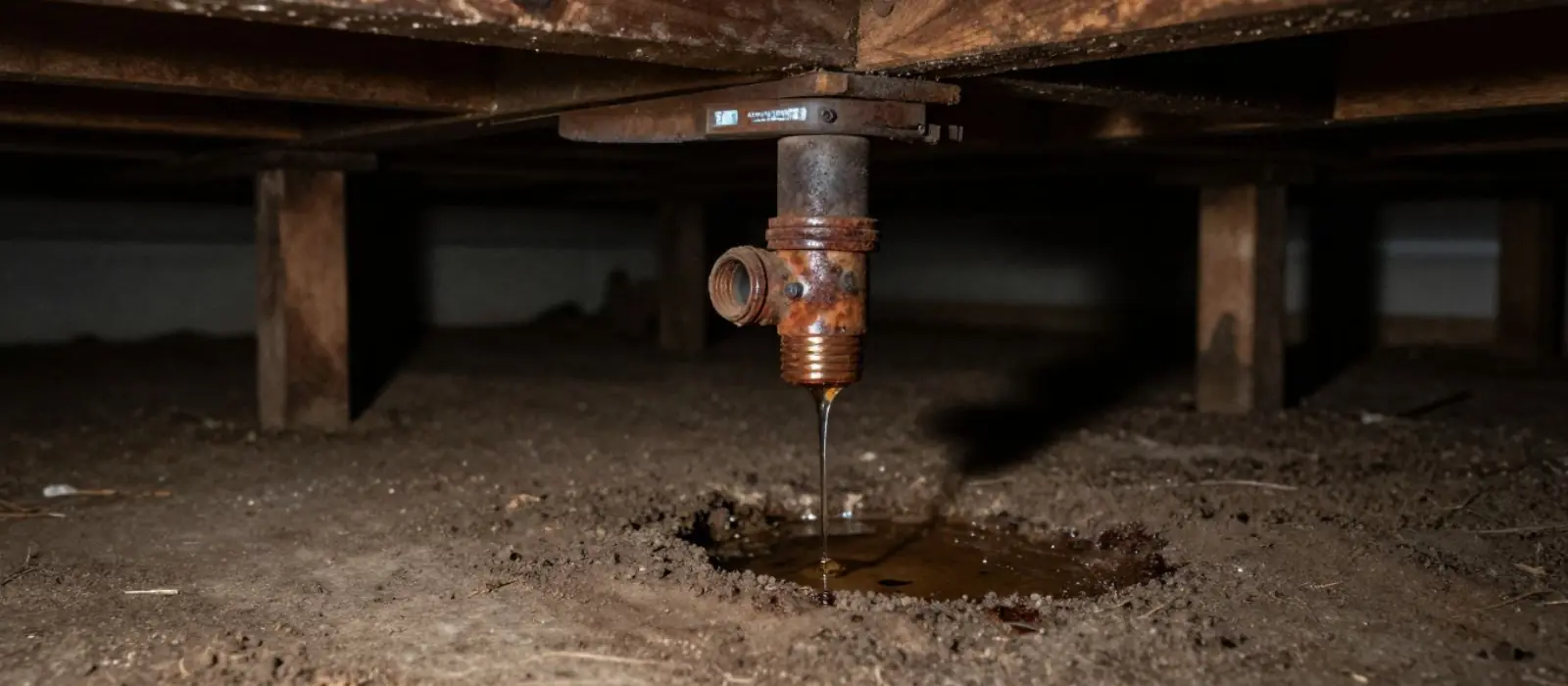
Does your South Gate home have a crawl space?
Crawl space water damage means water has collected or leaked under the floor of a house on a raised foundation. We pump out standing water, remove soaked insulation and dry the joists and subfloor above. The 24/7 line is answered around the clock, so call (213) 776-0579 as soon as you see water.
Not every South Gate home has a crawl space. Many are slab-on-grade, and we cannot say how many are which, so check your foundation type. Look for small vents along the outer wall or an access hatch in a closet or hallway floor. Slab homes are covered on the slab leak water damage page.
What you notice upstairs and what it points to
| What you notice | What it may mean | Your first move |
|---|---|---|
| Musty smell in closets or along the floor | Wet wood or soil below, possibly growth on the framing | Note where it is strongest and call |
| Floors that feel soft, bouncy or cupped | The subfloor has stayed wet long enough to swell | Keep weight off the area and call |
| Dripping or running sounds from the floor | An active leak, and the water is spreading | Close the main valve, then call us |
| Water visible through the access hatch | Standing water with an unknown source | Do not climb in, read the safety section |
A licensed plumber finds and repairs a leaking line, and we do not do plumbing work. We handle the water, the wet materials and the drying, and we can work alongside the plumber so the repair and the drying do not wait on each other.
Crawl space emergency: what to do right now
Stop the supply
If a pipe is the source, turn the main water valve fully off. If it will not turn, call your water provider's emergency line from your bill.
Call the 24/7 line
Tell us what you can see from the hatch, how deep the water looks and whether wiring or ducts run under the house.
Take dated photos
Photograph the water, the hatch and any stains or swelling above, from outside the crawl space, for your claim.
Call a plumber for a leaking line
The plumber repairs the pipe. Crews can start pumping and drying while the repair is arranged.
Safety before anyone goes under the house
Stay out of a wet crawl space
Do not crawl into a space with standing water. Wiring, junction boxes and sometimes a furnace or ducts run under many floors, and water plus electricity can seriously hurt you. Cut power only if the panel is dry and safe to reach, and call the utility or 911 first for a gas smell or any electrical risk.
If the water looks dark or smells like sewage, keep everyone out of the house area above it and tell us when you call.
How the crew pumps, strips and dries under the floor
The crew checks access and hazards first. Submersible pumps move standing water out, then extraction units and wet vacuums pull what remains from the soil surface and the wood. Our emergency water removal page describes the pumping step in more detail.
Insulation that has soaked up water is bagged and removed, because it holds moisture against the subfloor and dries slowly. Moisture meters check the joists and subfloor, and a thermal imaging camera helps trace wet areas above the floor. Air movers and LGR dehumidifiers then dry the framing, and drying mats can draw moisture from wood flooring above.
The EPA's mold guidance puts the deadline at one to two days for drying or discarding wet materials, which makes the first day under the house the one that counts. Where growth is already visible on wood, the mold remediation page explains that separate service.
ANSI/IICRC S500 is the standard restorers publish their water damage practice against, and you can ask any company how it follows it. Drying is finished when readings match those of unaffected materials, as explained on the structural drying page, not when the floor feels dry.
Water under your floor? Call now
The 24/7 line, (213) 776-0579, is answered around the clock.
What changes the cost of a crawl space job
- Depth of standing water and how much of the under-floor area it covers
- Access: hatch size, clearance height and distance to the wet area
- Water source and category, clean supply water or contaminated
- Amount of insulation and plastic sheeting that must come out
- Drying equipment needed and the number of monitoring days
- Whether joists or subfloor show damage that needs a rebuild
How insurance usually treats water under the house
Sudden and accidental damage, such as a pipe that fails without warning, is often covered by a homeowners policy. Gradual leaks and neglect often are not, and flood is usually excluded. Check your policy or ask your insurer, and keep dated photos and moisture readings ready.
Mistakes that keep a crawl space wet
- Waiting to see whether the water drains away on its own
- Sealing the vents or hatch while the wood is still wet
- Leaving soaked insulation hanging from the joists
- Pulling insulation out without gloves and a respirator
- Masking the smell with air freshener instead of finding the wet material
Local notes for South Gate crawl spaces
South Gate's older homes and the river
Wikipedia's history of the city puts most of its farmland-to-neighborhood buildout between 1910 and 1940, and many early homes were owner-built. An older house may have older piping and plaster over lath above its crawl space, so tell the crew the home's age and ask about testing materials before demolition.
Wikipedia's geography entry notes that the Los Angeles River runs through the eastern part of South Gate. Look up your address on the FEMA Flood Map Service Center and ask your insurer about flood coverage, since water coming in from outside is not handled like a plumbing leak. We do not state a flood zone for any address.
We also answer calls from Downey and Lynwood on the same 24/7 line.
Hear dripping under the house?
Call (213) 776-0579 and tell us what you see from the hatch.
Crawl space questions
Yes. The 24/7 line, (213) 776-0579, is answered around the clock every day.
Same-day visits depend on which crews are available. We do not promise an arrival time.
Look for small vents along the outer foundation wall or an access hatch in a closet or hallway floor. A house on a concrete slab has neither. If you are unsure, ask us when you call or check your home's records.
No, and you should not. Standing water, wiring and tight clearance make it unsafe. Tell us what you can see from the hatch and the crew goes in with protective gear.
No. A licensed plumber repairs the line. We pump the water, remove wet materials and dry the framing, and we can work alongside the plumber.
Usually, if it is soaked. Wet insulation stays wet against the subfloor and dries slowly. The crew checks it with a moisture meter and removes what cannot dry.
It can when wood stays wet for long. Quick pumping and drying limit the risk. Visible growth is handled as a separate service, and we do not promise any result for it.